Wednesday, 20 February 2013

Sallie Ford & The Sound Outside - Untamed Beast


Socks Off

In a nutshell: rock’n’roll echoed guitar – even the vibrato and simple licks of the Ventures - thudding drum beats, and the sassy vocal of Sallie Ford, all sounding like a rockabilly Shocking Blue. There are subtleties, as in the jazzy Shivers and noisy acoustic of Paris and quieter acoustic of Roll Around. Ends on the garage thump of They Told Me. Sallie Ford’s vocal rocks.

Monday, 18 February 2013

Barclay James Harvest, Ipswich Civic College - 1972

Tis in my memory locked, And you yourself shall keep the key of it...

So Will, who the Beelzebub is the 'yourself' and where do I find them?!

A little while ago I posted about missed concerts but also those attended in Ipswich and Felixstowe in the 70s [link] and a visitor kindly stopped by and prompted me to try and remember these. Well, I'm struggling! Could use any help from anyone with a better grasp of the past who attended that local triangle of venues - St Matthews Baths, Ipswich Civic College, Felixstowe Pier Pavilions - though there were others: I saw Curved Air at the Ipswich Arts Center; then there's the Gaumont Theatre where I saw early Supertramp, but then the soul bands were later.


Have managed to recall BJH at Ipswich Civic College, sans orchestra, though I did see them with orchestra at the Weeley Pop Festival in Clacton. Oh those were the days.

And then there was Essex University: John Martyn, Quintessence, Lindesfarne.....

Friday, 15 February 2013

Nashville - TV Series [2nd episode]


Sexy Chevrolet

The second episode of naff Nashville has consolidated its full appeal for me. In plot terms, little has advanced from the first outing, though the character dynamics have been fleshed out a little more, and literally in the case of Juliette Barnes and her short shorts. However, as a network production rather than HBO, it is constrained by well-established American prude-filters. This being the case, the gratuitous portrayal of cool cars usurps the titillation of homo sapiens, with Barnes again employing her seductive but now automotive charms on Deacon Claybourne [Rayna’s lead guitar player and former lover, now Juliette’s prey both for his guitar playing and manhood, though the latter is, as I have made clear, an implicit reality] by picking him up [right in front of Rayna, if you can believe that!], in a gorgeous blue vintage Chevrolet pick-up truck. To be fair, she has also tempted him with a $50,000 1930s Marshall acoustic guitar. And to be fairer still, he is prevaricating, but has bonked her [though we have had to deduce by imagining it].

There is the Dallasesque plot machinations of Rayna’s nasty capitalist father Lamar Wyatt – and I’m not sure who the good ol’ capitalist will be, but there will have to be one, naturally, being America – and that’s perfectly acceptable as it is to be expected. You can’t have a programme on Country music alone. What I am struggling with is the marriage of Rayna to the wet Eric Close, but that’s more to do with the fact that the fourth series of Friday Night Lights is being shown too at the moment and in that opening episode Connie Britton, now as Principal Taylor of Dillon High, is still passionately and romantically and totally believably behind her one true husband Coach Taylor even though he has just had to take over the coaching position at the run-down East Dillon High.

Richard Thompson - Electric [Deluxe Edition]

A Lesson in Enunciation

Of course this is excellent, and the rumbustious electric guitar tracks are full of trademark note bends and riff-sprints as only Thompson can play them. These are so often folk and punkrock sounds thrown together, with Thomspon’s lyrical elocution lessons anchoring them firmly to their Englishness.

And in this vein: I have always been a sucker for his ballads, the sadder and more miserable and cynical the better wrapped in their beauty - yet again, it is the enunciation that makes them so distinctive [well, the songwriting is simply as first-class as ever, so there has to be something else to write about]. It is as if the consonants will not depart from his lips without the absolute onomatopoeic torque of their noise having been pre-set then sprung with linguistic gusto. This can be taken to composition and pronunciation extremes: in The Snow Goose, an exquisite song, the line in the dream I am running down a street of molasses has that final syrupy word both over-deliberate as a metaphor but also in Thompson's sung pronunciation of the full o vowel sound, its syllabic pace also slowed so that every emphasis on word and sound is highlighted. Perhaps that primary school up-North which has banned local vernacular in children’s talk will be piping his singing into classrooms on Thompson Tannoys....

Across the two cds of the deluxe edition, these are the slower songs for those who, like me, might want to create alternative set lists: The Snow Goose, I Found a Stray, My Enemy, Another Small Thing In Her Favour, Saving The Good Stuff For You.

And if you think I’ve gone completely soft, I can also recommend the stompers Sally B and Stuck On The Treadmill, this latter with amazing guitar and bass in-tandem romping. But really, both cds are full of Thompson excellence, and produced to perfection by that other great, Buddy Miller.

Thursday, 14 February 2013

Remembering Trev


It will be scrolling through a music site and seeing
Peggy Lee, one of your great loves, thinking I could
record for you – how easy for a second to forget;
finding that page of saved rude cinema posters
never sent, or coming across your imaginary ribald CV
and then the one composed for me as if written by the
Marquis de Sade: trying to provide a twin credibility
at an early age of looking up to your darker but not yet
so darkened side. I have re-read the few emails I kept,
wishing they all were there amongst the greater amount
of trivia - messages across such increasing gaps of time
in my being unaware. And today, in the TSO carriage-
cafe drinking coffee, I am struck by the significance of
trains, and the  love of them ending your pains.

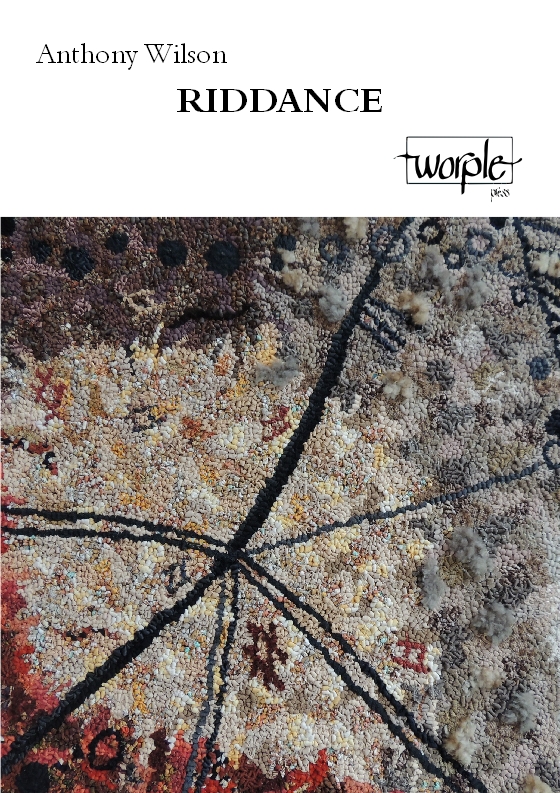
Anthony Wilson - Riddance


Uplifting Experience

In Peter Reading’s 1984 collection C, he presents the poetic paradox of being unable to write about Cancer/illness/death and yet ‘(Incongruously I plan 100 100-word units.)’ to do so in this dark and complex work. There are moments of bleak humour, but little that is uplifting in this ‘Terminal verse’, unless the other C of candour will suffice. But poetry does not suffice for Reading,

‘Why? Snot, gore, filth, suppuration of the arse-gut – for these no metric is vindicable.’

In Anthony Wilson’s recent collection Riddance where he deals poetically with his own cancer, the creativity carrying his candour is wonderfully uplifting, as it is also humorous and honest and unflinching amongst many other enduring attributes.

I had the great pleasure of attending Anthony’s launch of this poetic collection on the 17th September 2012 at the Bike Shed Theatre in Exeter. The attendance for this was amazing – tribute to the high regard from so many for Anthony as a person of considerable humility and warmth, for his journey with this cancer, and for his talent as a writer.

I read and wanted to review Riddance almost immediately, wishing to share in its significant appeal, but have found it a more complex work than I originally imagined and thus have lived with it rather than quickly treat as a product. This complexity beneath its otherwise freshness of direct accessibility is one of its many strengths, and in characterising this now, I want to light-touch as a review and tempt anyone reading to discover for themselves the ease with which you will follow Anthony’s vindicable poetic exploration. Where Reading’s objective stance struggled [though this was his ruse], Anthony’s subjectivity succeeds.

The opening poem ‘Tumour’ encapsulates as a title the directness of the telling throughout the book. There is no need for metaphor or other embellishments. I like the unsentimental honesty of lines like

‘I would like to claim
new attention to my children
but the truth is they grew up
whether I watched them or not.’

In ‘How to Pray for the Dying’, the concluding line ‘Try saying ‘Shit happens.’’ reinforces the lack of sentimentality, and in its secular declaration, he avoids the cloying spirituality one would find in others’ writing – which isn’t to say these poems are devoid of spirituality. That is a feature of the unravelling depth and complexity they offer over several readings.

The list poem ‘Lost’ is bookended with the lines ‘Lost my hair’ which asserts the humour found in many poems, but also that sensible grasp of priorities: being bald is more critical a reality than agonising over whether to rail against an uncertain god. This humour is continued in the delightful ‘Homeshopping’.

The poems I am focusing on are largely from the first section ‘The Year of Drinking Water’ and they establish aspects of discovery/realisation/pain/fear/acceptance/recovery, themes which are revisited throughout all five sections of the book. Whilst the fifth is titled ‘Reasons for Life’ these reasons are plotted in poems throughout all the sections, often directly or by extrapolation.

I also like the playfulness of many poems, like ‘Words’ where the distancing of not quite clinical but key diagnostic terms suggests much about isolation and pause and focus as the emotive response to hearing these. This gets an oblique repeat it seems to me in ‘I am Fighting’ with its echoes and repositionings of meaning.

In ‘Heads’, Anthony returns comically but by its very mentioning again the very visible consequence of cancer and treatment in being bald,

‘I’m Kojak without his lollipop,
a paunchy Duncan Goodhew and haggard
Syd Barrett on his bike.’

The physical manifestations of this illness are what he and others so readily see – it is only in this retrospective telling [though much clearly written during] that deeper truths are conveyed.

The close observation in the poems ‘I am Becoming my Grandmother’ and ‘Man in a Fleece’ account for further physical but also behavioural changes – real and imagined – that attend the progress of the cancer and treatment. The humour now is more sardonic, but there is also the poetic imagining at work which perhaps finds a beauty that Reading could not, for example, achieve [or attempt to achieve],

‘I stroke my second skin.
It catches the light in beads
which ripple up then down my arms.’ [‘MIAF’]

In the poem ‘Blood’, a visual and tactile description leads to the telling line ‘....you seem stable as mercury./If only.’

In ‘The End of the Affair’, a poem that recounts the recovery and defeat – though we will be taken through the processes again and again: this being an aspect of the overall complexity I hadn’t noticed at first – we get the first dialogue with an illness that has gone but can never go away as an experience,

‘My days grow fat without you.
There are rumours of gales.
No, I don’t think we can be friends.
I would rather you didn’t write.’

Indeed, in section three ‘Riddance’, we get a poem like ‘The Clothes I Bought During Cancer’ which is all about discarding and change. In ‘Playing Dead’ Anthony recalls what is presumably an early MRI scan. And in ‘Probably Nothing’ we are reminded though a poem of childlike verses the grown-up reality of beating this disease,

‘You won
        you beat it, they say.
No I didn’t.
        But it did go away.’

These references merely scratch the surface of a book that startles in its apparent simplicity. The account of being diagnosed with non-Hodgkin’s lymphoma [7 years today] through to remission is told with candour and considerable grace, the subjectivity having an innate power no metaphor could hope to deliver. The poetry is in the tones and emotions, the playfulness at times, the precise placings on the page [Anthony Wilson has always been an excellent craftsperson] and the total lack of any self-pity. It is, as I have said, an uplifting experience to read.

Anthony's website with details of how to purchase Riddance: [link]

Tuesday, 12 February 2013

Anaïs Mitchell & Jefferson Hamer - Child Ballads


Melted

Willie of Winsbury is perhaps one of the most beautiful melodies of all time, and this is complemented by one of the finest folk tales of all time: though it is anathema for me to warm to a dictatorial monarch/parent and the triumph of one more of the landed classes. However, the love story of Janet [and must be Janet, not Jane as is sometimes sung] and William is itself such a romantic triumph. Then there are the great lines, as when the King/father sees William for the first time and declares if I were a woman as I am a man, in my own bed you would have been.

The version of this on Child Ballads is itself one of the most beautiful I have heard. John Renbourn’s will probably always be the touchstone for a tender and warming rendition, and another more recent excellent outing is on Meg Baird’s 2010 album Dear Companion. Anais Mitchell and Jefferson Hamer present a faithful performance, and it is the perfect companionship of their singing that works so wonderfully here, Hamer’s sweetness the surprising vocal empathy to Mitchell’s slightly tart tones, but itself a blissful marriage of sound. The pump organ provides such a glorious base throughout. Worth the price of this album entirely on its own.

The other six ballads from the collection of Sir Francis James Child consolidate the folk credentials on this honest and simply superb album. Final song, the Scottish ballad Tam Lin, tells another yet more metaphorical story of pregnancy and ultimate true love. But none doth compare with the opener which has melted my aural affections as did Janet’s for her Lord Willie.